

Solutions
- TOP
- Solutions
- Case Studies
- OPC UA Information Model Support
-
- Water supply case
- User Configurable Driver Function
- Eliminating Data Loss with OPC UA Historical Access
- External Configuration Function
- Sparkplug B Client Support
- OPC UA Information Model Support
- OPC UA x MCP Adapter for AI Agent
- Exploring the Potential of OPC UA Historical Access and Information Models
OPC UA Information Model Support
In manufacturing environments, OPC-based connectivity has become widely adopted, and acquiring data from devices made by different vendors is now standard practice. However, the structure and semantics of the acquired data often depend on individually designed implementations, making cross equipment reuse and scalability difficult.
DeviceXPlorer OPC Server by TAKEBISHI offers extensive device connectivity, supporting more than 400 device series from 100 vendors. In Version 7.6, a new function that supports the OPC UA Information Model will be added.
This article introduces the efforts to integrate both connectivity and structured data modeling.
1. Challenges of Data Structure That Emerge After Connectivity
Manufacturing sites include a mixture of equipment such as PLCs, industrial robots, machine tools, and various controllers, which differ based on both generation and manufacturer. While OPC-based communication connections are becoming common, a key practical challenge remains: how to standardize the interpretation of data across different applications and systems to ensure consistent and unified use.
In many cases, data is exposed as individual tags. However, information such as which functional unit a tag belongs to within the equipment, or what units and meaning the tag represents, is left to external system design. As a result, upper-level systems often need to build their own data models, requiring redesign every time equipment is expanded or replaced. This dependency on structure becomes a burden in terms of scalability and maintainability.
2. Ensuring Structure and Reusability Through the Information Model
The OPC UA Information Model provides a framework that defines the address space not as a flat list of variables but as structured information. By combining object types, variables, references, and attributes, it enables hierarchical representation at the equipment or functional level.
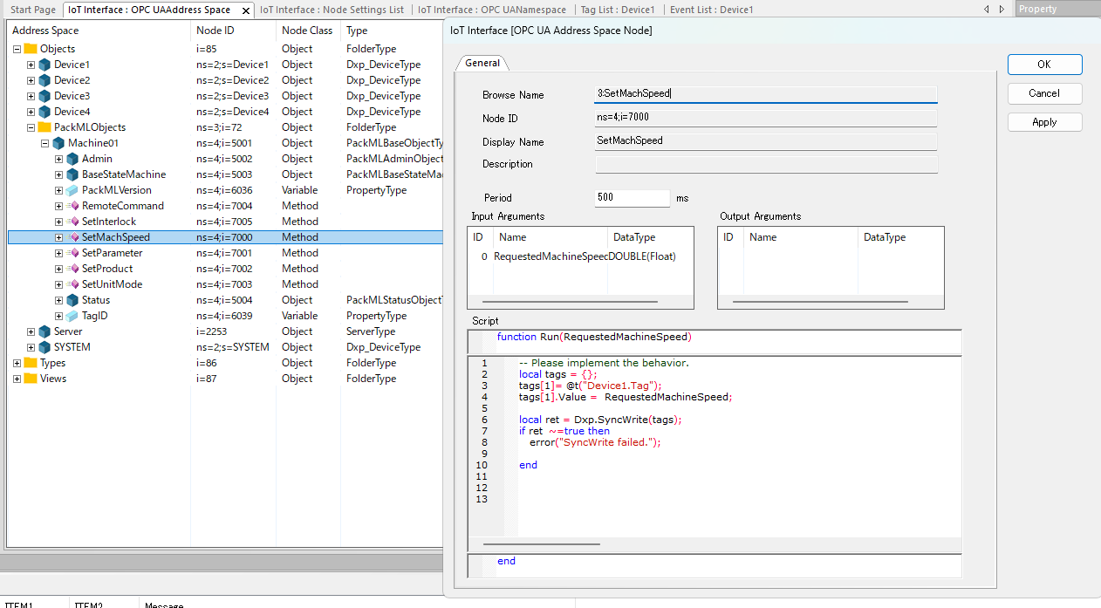
The Information Model goes beyond simply defining data structures. By incorporating methods, state machine models, and event notifications, it enables standardized representation of device behavior itself.
Through this structure, data is published as part of an equipment’s functional context rather than as simple values. Clients can access information while understanding the functional meaning and relationships between nodes, enabling semantically aware usage and advanced autonomous collaboration.
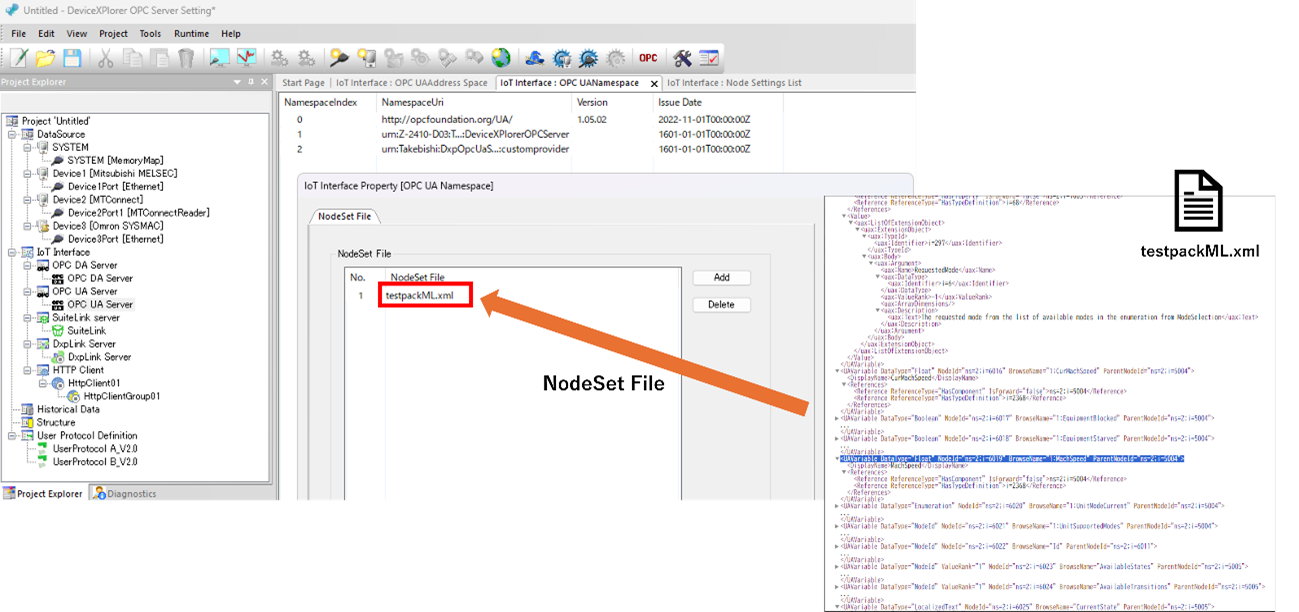
Information Models are defined in XML format (NodeSet2), which explicitly describes node definitions, type information, references, and data types. A server can load this definition to construct a pre-designed address space. Because the model is managed externally, it becomes easier to reuse and revise while reducing dependency on implementation code.
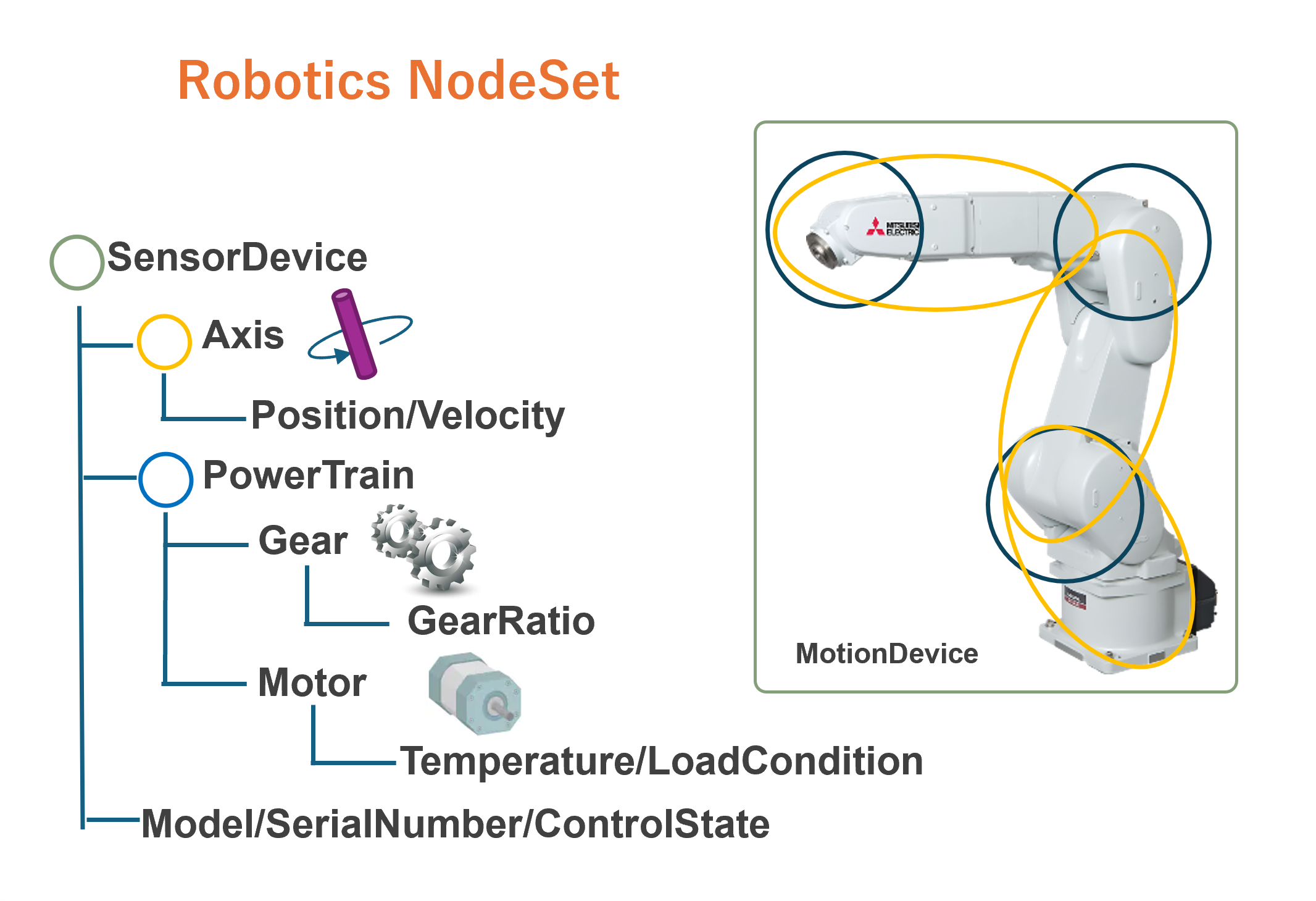 Robotics_NodeSet2
In recent years, the OPC Foundation has been actively collaborating with industry standards associations to develop OPC UA Companion Specifications. These specifications now exceed 100 types across a broad range of fields including machine tools, robots, semiconductor equipment, and energy systems. This has encouraged the development of industry wide shared information models.
However, Companion Specification adoption requires advanced expertise. Designing NodeSets, defining types, and mapping to existing data all demand significant effort, and implementation costs sometimes hinder wider adoption. Even though standards exist, the practical environment for easily deploying them on the shop floor is still insufficient.
In this way, while the standardization of information models is steadily progressing, implementation workload and required expertise remain obstacles to broader adoption. To make information models truly practical on the factory floor, an approach is needed that integrates them with existing connectivity platforms and reduces implementation and operational hurdles.
TAKEBISHI is addressing this challenge by integrating OPC UA Information Model functionality into DeviceXPlorer OPC Server.
3. Integration of the Connectivity Platform and Information Model
DeviceXPlorer OPC Server has long provided an extensive connectivity platform designed to support environments where equipment from multiple manufacturers coexist. This foundation has enabled unified acquisition of data from a wide range of control devices.
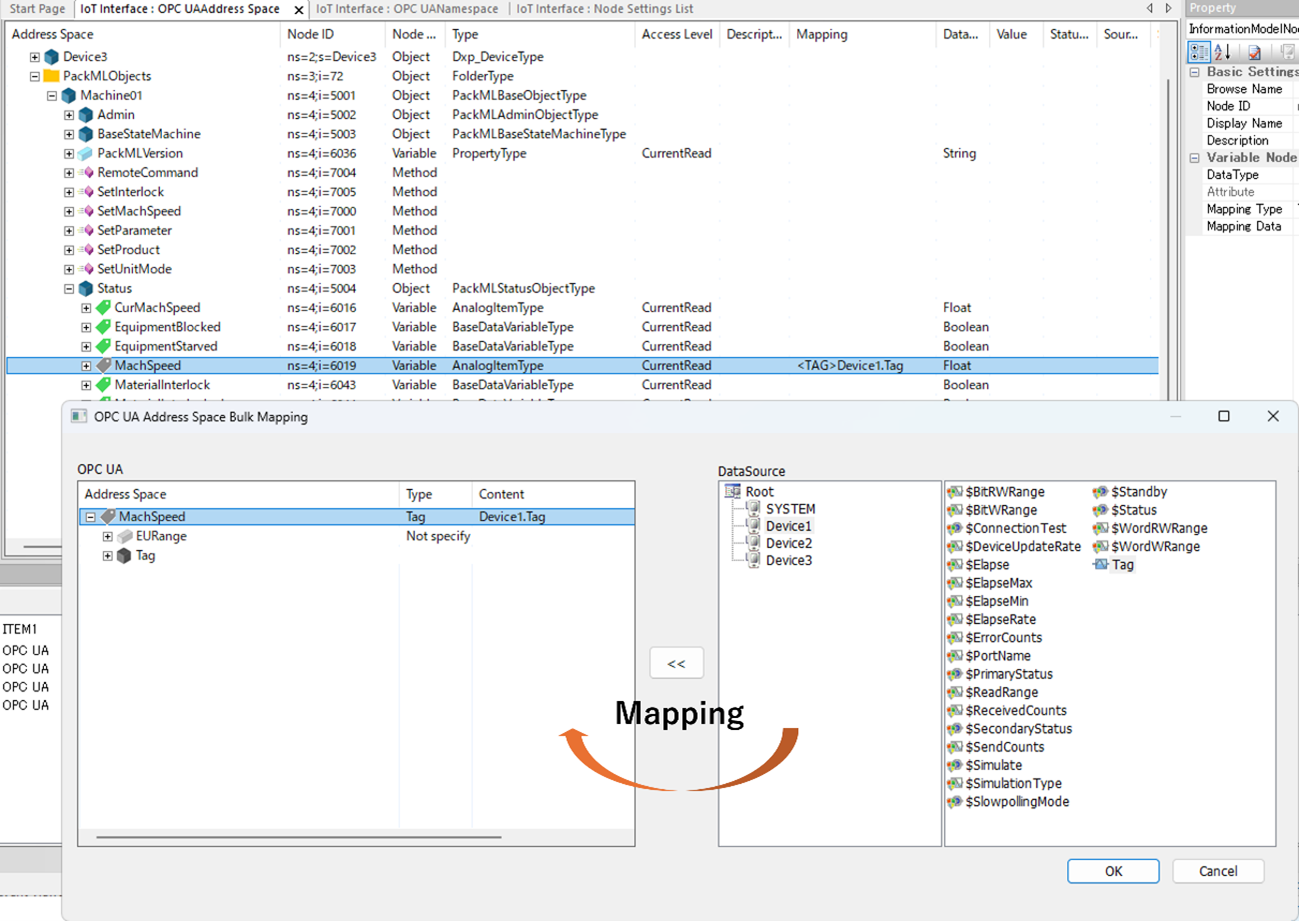
In Version 7.6, OPC UA Information Model support is added to this connectivity platform. Data acquired from each device can now be mapped to an XML-defined information model and exposed as a structured address space.
The key point is that the information model capability does not exist independently; it is integrated with a proven, broad-coverage connectivity platform. This makes it possible to publish data from devices with different communication specifications using a common structure, greatly simplifying cross-equipment data integration. As a result, upper-level systems can minimize their individual mapping work, reducing design overhead during system expansion.
4. Toward a Standards-Based Information Publication Platform
For advanced utilization of manufacturing data, establishing communication is not enough. Data must be published in a meaningful, structured form. Organizing data based on standards and providing it in a reusable format is essential for ensuring interoperability.
With the addition of information model support, DeviceXPlorer OPC Server evolves from a communication middleware into a standards-based information publication platform, built upon decades of proven connectivity. As a foundation that enables data integration beyond vendor-specific boundaries, it contributes to improved scalability and reusability across manufacturing sites.
The interoperability that OPC aims for is not achieved solely by complying with specifications. What matters is the ability to provide data within a common information structure in environments where equipment from different vendors coexist. This initiative brings that concept into concrete implementation at the factory-floor level.